Emergency Water Extraction Cost in NYC (From $3/sqft)
Jan 5, 2026
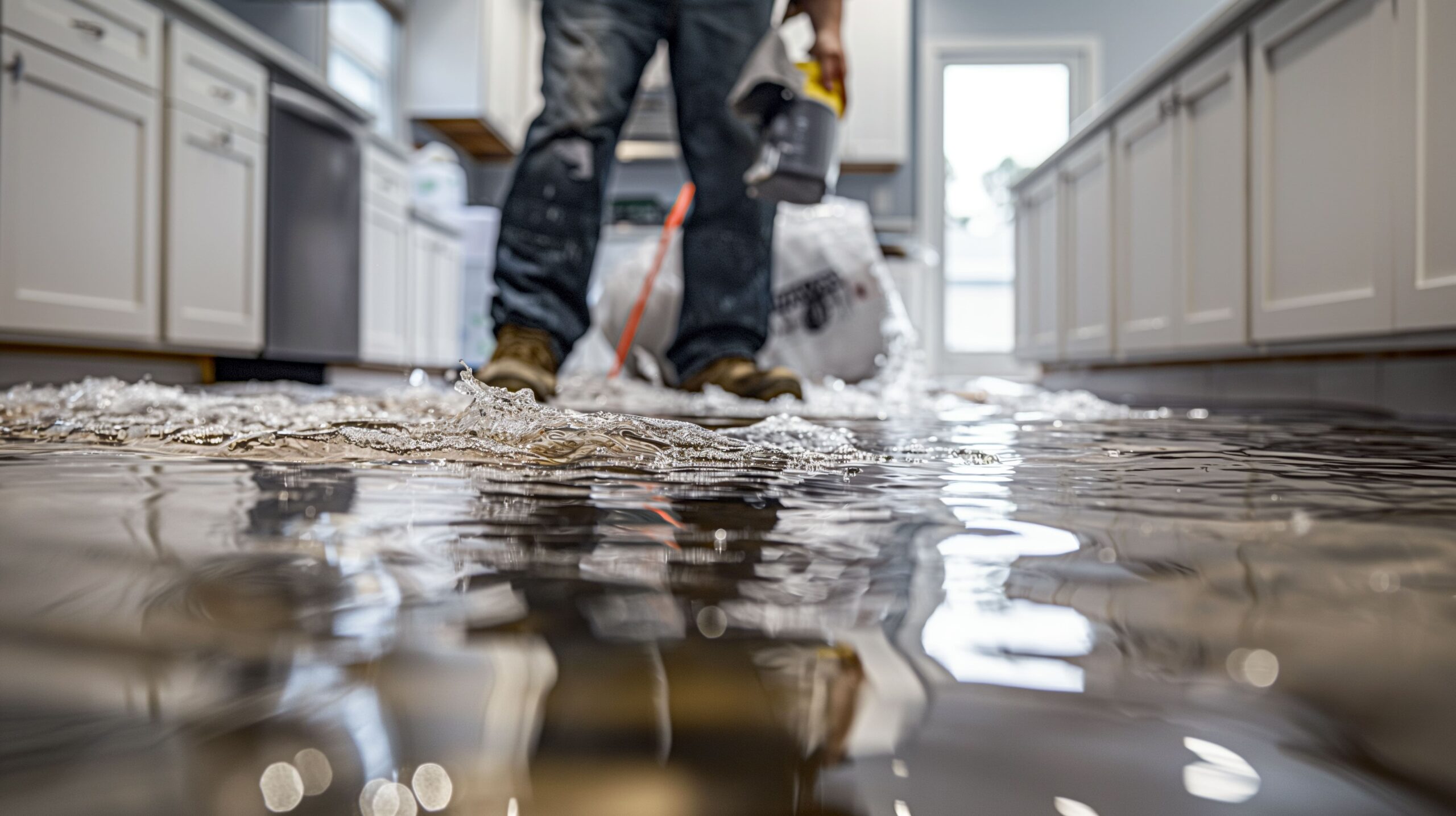
When water is moving through a room, the numbers start moving too.
In NYC, emergency extraction alone can run a few thousand dollars before anyone even reaches the drying phase. And that range widens fast with contamination, access issues, or deep saturation.
It’s hard to gauge what’s reasonable when every building and every loss behaves differently.
We’ll break down emergency water extraction cost in NYC so you can understand what drives the bill and where the real variables sit.
Key Notes
NYC emergency extraction typically ranges $3–$15 per sq ft, driven by category and saturation.
Gray and black water raise costs significantly due to demolition, PPE, and disinfection needs.
Commercial and basement losses trend higher from access issues, equipment demands, and compliance steps.
Why NYC Water Extraction Prices Swing So Much
In NYC, pricing is shaped by four realities:
Water type (category): Clean, gray, or black water. Contamination dictates PPE, demolition, disposal, and how much can be dried in place.
Extent and absorption: A small, surface‑level spill is one thing; moisture inside walls, insulation, subfloors, or cabinets is another.
Access and logistics: High‑rises, elevators, after‑hours entry, street parking, and long hose runs increase labor time and equipment needs.
Urgency and staffing: Night or weekend call‑outs and “all‑hands” responses to stop mold or business interruption cost more than a weekday slow roll.
Nationally, water removal plus drying often ranges $5–$15 per sq ft. NYC usually lives toward the top of that band due to labor and overhead.
Emergency Water Extraction Cost in NYC: Quick Overview
NYC extraction + initial dry‑out: Typically $3–$15/sq ft, depending on water type, saturation, access, and timing.
Small to mid emergency responses: Often $2,500–$3,500 to mobilize, extract, and set equipment.
Why the spread? Category and absorption. Clean water in a 200 sq ft room can be dried in place; black water in the same area likely needs demolition, disinfection, and disposal.
Cost by Water Category (Clean, Gray, Black)
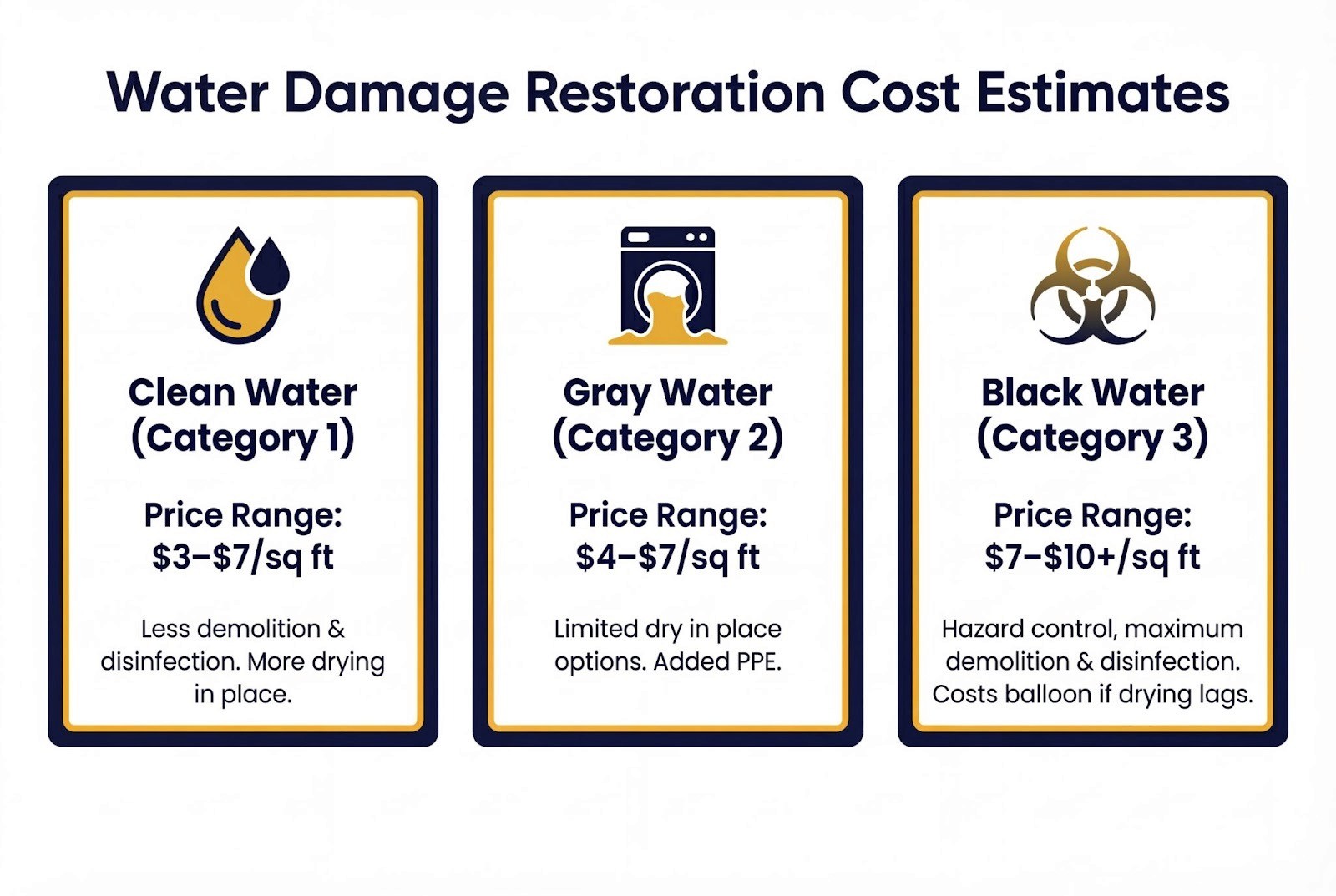
Clean Water (Category 1)
Often from supply lines or appliance leaks.
The typical cost for water damage restoration at the mitigation stage lands around $3–$4/sq ft for clean scenarios, and up to $3–$7/sq ft when materials are thicker or more absorbent.
More items can be dried in place = less demolition and disinfection are needed.
Gray Water (Category 2)
Lightly contaminated – think detergent lines or appliance overflows.
Pricing usually steps up to $4–$7/sq ft, with some NYC cases reaching the upper end of national estimates when cleaning and containment expand.
Expect more limited “dry in place” options and added PPE.
Black Water (Category 3)
Sewage, river/flash flooding, or anything clearly contaminated.
Demolition drives cost here. You’ll often see $7–$10+/sq ft, with severe or specialty scenarios quoted in the low teens – and yes, specific edge cases can climb higher.
It’s not just extraction, but also hazard control (maximum demolition, disinfection, documentation, careful disposal). That’s also where mold and water damage repair costs can balloon if drying lags.
Rule Of Thumb:
For the same area, gray water is ~1.2–1.6× clean water pricing, and black water is ~2–3× clean water pricing.
NYC tends to ride top‑end because labor, logistics, and building rules stack up.
Extent and Class of Damage
How far and how deep the water traveled is one of the biggest cost drivers.
Restoration pros look at both spread and absorption to determine the IICRC “class” of damage.
Light, Contained Damage (Lower IICRC Class)
Surface-level moisture
Minimal absorption into walls or flooring
Typically stays at the lower end of the cost range
Often no demolition required
Moderate to Deep Saturation
Costs increase when moisture reaches:
Behind walls
Into insulation
Under hardwood or tile
Across multiple connected rooms
Into cabinets or built-ins (toe-kicks, interiors, backing)
This adds labor, equipment, and drying time – and usually triggers selective demolition.
Why Square Footage Isn’t Linear
A small 300 sq ft space with deep saturation can cost more than a cleaner, shallow 500 sq ft loss because:
Drywall cuts, baseboard pulls, or insulation removal are required
Airflow is harder to create in tight layouts
Cabinet or subfloor drying requires specialized setups
Once demolition enters the scope, pricing shifts from simple extraction to a combined package of:
Pumps and extraction
High-capacity drying equipment
Controlled tear-out
Disinfection and disposal
The job becomes less about the footprint and more about the complexity of what got wet.
Residential vs Commercial Costs
Residential and commercial water losses follow the same core principles, but the pricing realities in NYC are very different once you factor in scale, urgency, and building systems.
Residential Costs
Residential jobs are usually:
Contained to one unit or a few rooms
Easier to access
Less complex in terms of airflow, permitting, and scheduling
Typical residential extraction + drying in NYC:
$1,000–$5,000 for 200–1,000 sq ft of moderate clean or gray water damage. Black water pushes the total higher due to required demolition and disinfection.
Commercial Costs
Commercial losses cost more even at matching square footage because they involve:
Larger equipment packages (more air movers, more dehumidifiers)
Off-hours or overnight work to avoid business disruption
Strict documentation and compliance requirements
Additional system-related tasks like HVAC, plenum, or ceiling void cleaning
Commercial extraction and drying commonly land at:
$5,000–$20,000+, depending on contamination, access, and operational urgency.
Why The Gap?
Even when per-square-foot numbers look similar on paper, commercial restoration carries added layers of logistics and liability. Faster turnaround times and bigger footprints push the total well above the typical residential range.
Basement Water Removal in NYC
Basements come with their own set of challenges – poor access, stairs, limited discharge points, moisture‑loving concrete.
For a standard 500–800 sq ft basement with moderate flooding, NYC removal + initial dry‑out commonly sits $2,000–$7,000 (average near $4,000), trending higher with deeper water, heavier contamination, or larger footprints.
For a 500 sq ft basement, ballpark per‑type pricing looks like:
Clean (Cat 1): $3.50–$4.50/sq ft (≈ $1,750–$2,250 total)
Gray (Cat 2): $4.50–$6.00/sq ft (≈ $2,250–$3,000 total)
Black (Cat 3): $6.00–$7.50+/sq ft (≈ $3,000–$7,000+ total)
Basements often need more dehumidifiers for longer, frequent mold checks ($500–$2,000), and sometimes sump pump testing or replacement.
Larger spaces (1,000+ sq ft) or several inches of water can push totals $5,000–$10,000+ before any rebuild.
Hidden/Secondary Costs (Where Budgets Blow Up)
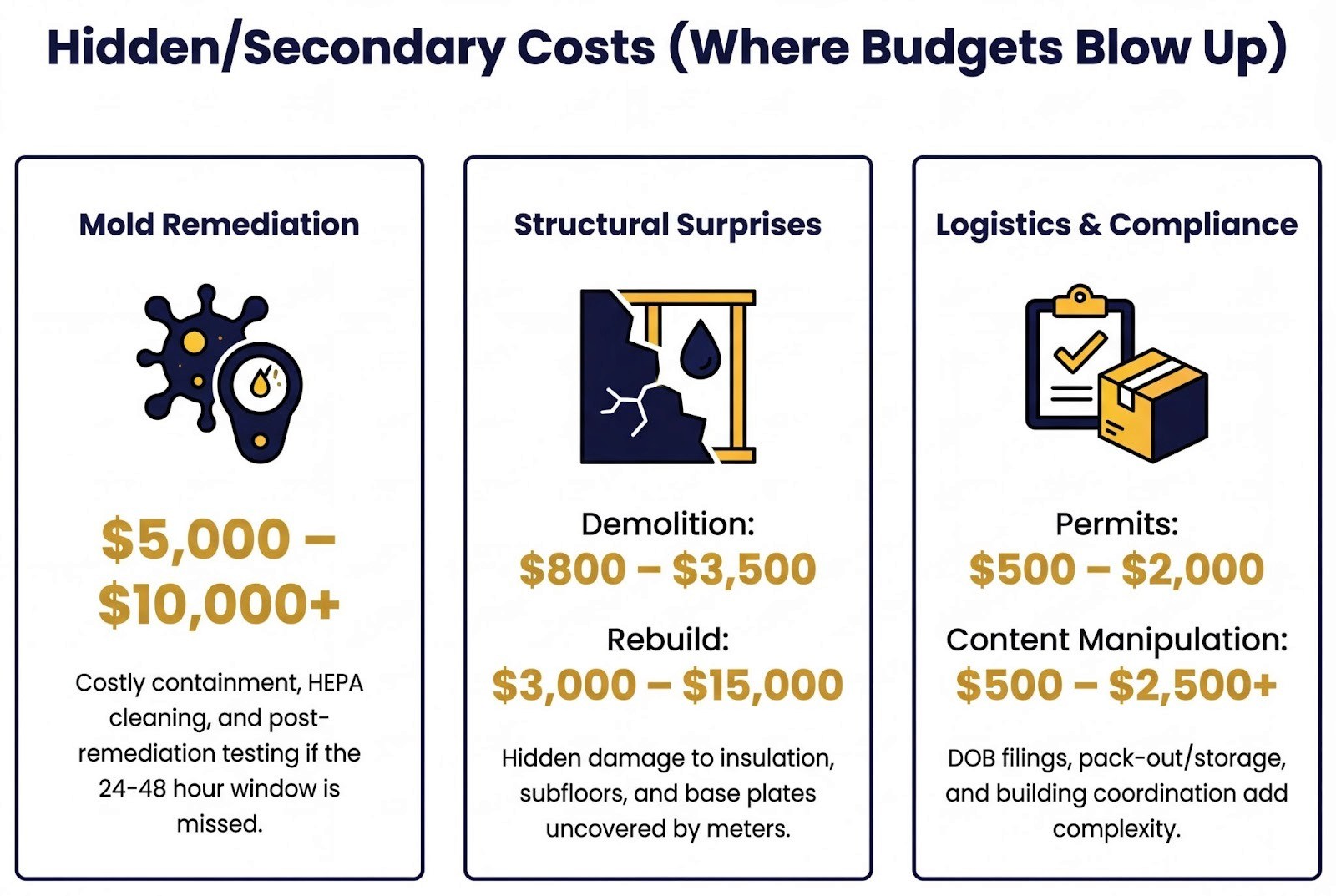
Mold Remediation
The 24–48 hour window is real. A $2,000–$4,000 dry‑out can turn into $5,000–$10,000+ once containment, HEPA cleaning, and post‑remediation testing enter the chat.
Insurance may exclude mold if it isn’t clearly tied to the covered loss.
Structural Surprises
Moisture meters and thermal imaging find what the eye misses: wet insulation, saturated subfloors, and swollen base plates.
Demolition and disposal add $800–$3,500 for many jobs. Rebuild ranges stack on top, often $3,000–$15,000 depending on finishes.
Logistics & Compliance
Permits and DOB filings for walls/ceilings can run $500–$2,000.
Content manipulation (pack‑out, storage) runs $500–$2,500+. In co‑ops/condos, building rules and neighbor coordination add time.
If you’re pricing carpet water damage repair cost, factor in pad replacement, antimicrobial treatments, and the reality that some carpets simply can’t be saved after gray/black water.
Insurance & Water Damage in NYC
Understanding what insurance will (and won’t) cover can save you from expensive surprises – especially when emergency extraction and drying start immediately.
What’s Typically Covered?
Most HO-3 homeowners policies cover sudden and accidental water damage, including:
Burst pipes
Supply-line failures
Appliance malfunctions
Coverage usually includes:
Emergency water extraction
Drying equipment
Code-compliant repairs
All minus your deductible. Gradual leaks, long-term moisture, and neglect are almost always excluded.
What’s Not Covered?
Flooding from outside sources falls under NFIP flood insurance, not your homeowners policy.
That includes:
Stormwater and surface flooding
Tidal or river flooding
Many sewer backups
NFIP may cover basement extraction, but often excludes:
Below-grade improvements
Temporary living costs
Certain debris cleanup expenses
Always review the fine print – this is where most coverage misunderstandings happen.
A Claims Rhythm That Protects Your Payout
To keep your claim clean and defensible, stick to these four steps:
Document fast. Photos, videos, and moisture logs from day one.
Stop further damage. Shut off the source, extract water, and start drying immediately.
Engage early. File promptly; most adjusters visit within a few days.
Track scope changes. If demolition grows, keep written records.
NYC Scenarios & What They Cost
Small Bathroom Leak, Cat 1 (120 sq ft)
Quick extraction, a few air movers, one dehumidifier, 2–3 monitoring visits. $800–$1,400. No demolition.
Kitchen Supply Line, Cat 1–2 (350 sq ft)
Cabinets toe‑kick removal for airflow, baseboard pulls, multiple dehumidifiers, 3–4 days drying. $2,400–$4,200. Selective drywall cuts if moisture lingers.
Basement Wash, Cat 2 (650 sq ft)
Pump‑out, aggressive extraction, heavy dehumidification, sanitizing, slab moisture monitoring. $4,000–$7,000. Mold check optional but recommended.
Sewage Backup, Cat 3 (450 sq ft)
Full PPE, containment, flooring removal, lower drywall demo, disinfection, negative air, disposal. $6,000–$12,000+ before rebuild.
Commercial Office Suite (700 sq ft, after‑hours)
Large crew off‑hours, coordination with building ops, higher equipment counts to reopen by morning. $6,000–$10,000+ depending on finish level and HVAC involvement.
Looking For Same-Day Dry-Out Guidance?
Get moisture mapping, extraction, and insurance documentation.
Frequently Asked Questions
How long does emergency water extraction usually take?
Most NYC extractions take a few hours, but drying can run 2–4 days depending on saturation and materials. Deep moisture in walls or subfloors extends the timeline.
Do I need to move furniture before extraction crews arrive?
Not always. Crews can shift or block furniture as part of the job, but heavy items, pianos, or electronics may require advance planning or additional handling fees.
Can hardwood floors be saved after significant water exposure?
Sometimes. Clean water caught early has a chance; gray or black water almost always requires removal. Even with clean water, cupping or buckling may appear during drying.
Is emergency extraction required if moisture isn’t visible?
Yes – water migrates behind surfaces quickly. Even without standing water, trapped moisture can cause mold, odors, and structural issues. Moisture mapping confirms whether extraction is needed.
Conclusion
Emergency water extraction cost in NYC comes from the category, saturation, and how fast you act.
Clean water in a small room may land near $3–$4 per sq ft, while gray or black water can push $7–$15 per sq ft once demolition and sanitizing enter the plan. Basements trend higher, commercial jobs carry a 20–50% premium, and delays open the door to mold, structural repairs, and insurance arguments you don’t want.
If you take anything from this guide, let it be this: speed lowers cost, and documentation protects you.
If you need clarity on your own water loss – whether it’s extraction, drying, or figuring out what your insurer will accept – we can walk the space with you, map the moisture, and give a clear quote. Reach out for a free estimate anytime.